The room
A vacant storefront with a drum kit in it
The alley behind Willits Street is a block from Birmingham City Hall. In 2020 the unit at 237 was empty, and then it wasn't.
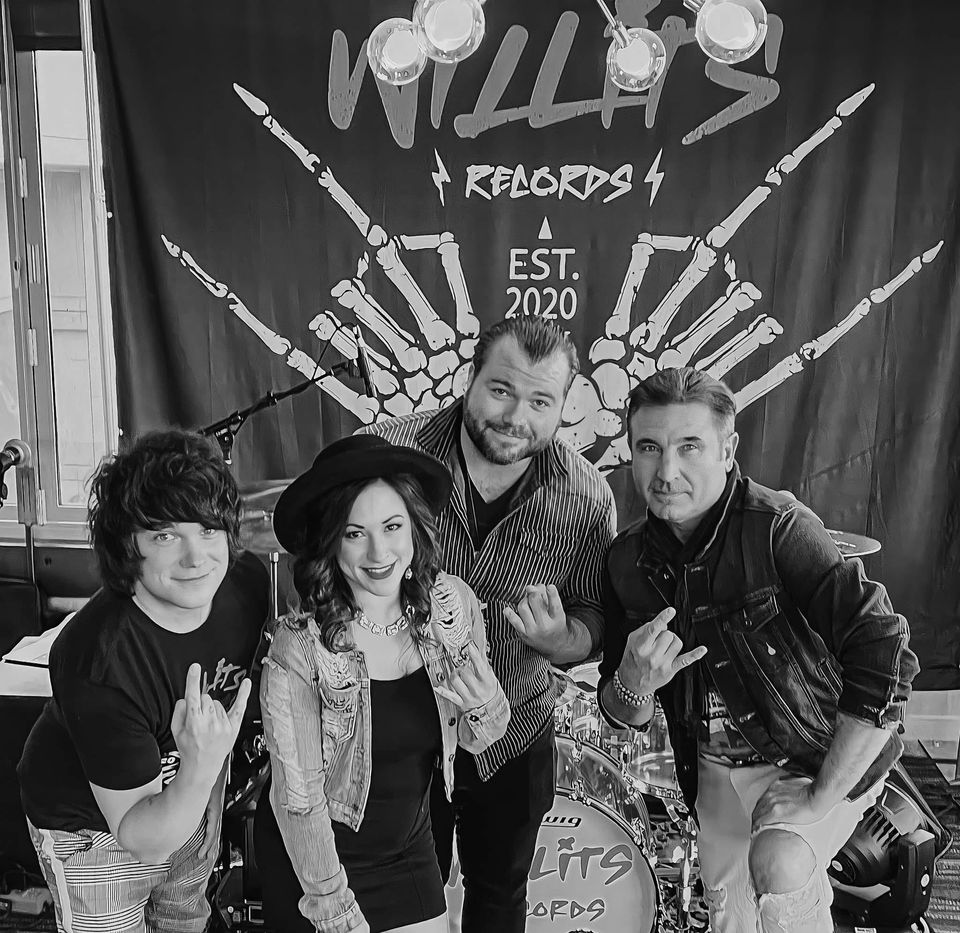
What went in was a record label, a rehearsal room, and a stage — a 90s cover band's clubhouse with a name on the door. Online it read like what it was: an independent label, a production company, a punk-pop cover outfit, and a room you could rent for a private party. It advertised itself, without much modesty, as the best place in Birmingham to hold a bachelorette party.
There were show dates posted with fees attached. There was a line about messaging for a private table. And there was a membership: three hundred forty-nine dollars a month for live music on select nights, a keycode that worked around the clock, free entry to anything happening in the room, and the right to throw your own party in it once a month.
Everything a police officer would later need to build a case was posted publicly, by us, in advance.
Suggested file: assets-src/willits-storefront.jpg
Why
There was nowhere else to be
The rooms we played were closed or capped to nothing. The room was not a loophole. For a while it was the only place we had.
Musicians had no work, and neither did the people who load their gear, run their sound, or fill their rooms. There was no date to count toward. What 237 offered was small and specific: a few hours, a band playing loud, and a couple hundred square feet where the last twelve months did not apply.
Some of the people who plugged in there had filled real rooms for a living, and you would know the songs. They drove to an alley in Birmingham to play for forty people, because a year of not playing does something to a musician that is difficult to explain to anyone who does not do it. They did not come for a fee. They came because they needed to play and there was nowhere left that would let them.
It was also, plainly, a refusal. The room stayed open because the people in it had decided something was being taken that should not have been, and that waiting quietly for permission was not the answer.
That is the part sixteen citations cannot describe. A fire code violation is a fire code violation. It is also, in this instance, forty people standing close enough to hear each other.
Music matters most when it is the thing you are not allowed to have.
Drop them in assets-src/ and they go in uncaptioned.
The list
Everybody wanted on it. The city most of all.
Word traveled a lot further than it should have for a room with no sign on it.
Nothing was ever announced. A particular post would go up on Instagram and that was the entire signal — if you knew what you were looking at, you knew the room was open that night. If you did not, it was a photograph.
People drove in from out of state for a Tuesday, and from two hours out on a weeknight. What most of them wanted was not a ticket for the night — it was a place on the list: the keycode, the standing invitation, the room whenever it was open.
Not everyone got one. The ones who did were touring musicians off the road, people whose names you would recognize, people who run things, and people who simply wanted to stand somewhere that had not been closed. Some of them could not get to Michigan at all and watched a set over a video call from two thousand miles away.
The list came first. If you were not on it you were most likely not getting in — and on the nights somebody was waved through anyway, it cost fifty dollars at the door. That is what the chief of police paid.
The door was not amateur hour. Security was contracted out — professional bouncers brought in from an established room in the city, working it the way they would work any other night. A list, a door, and paid staff on that door. Whatever the city found wrong with the paperwork, the room itself was run.
One rule outranked every piece of paperwork the city cared about. Anyone who got aggressive toward a woman in that room went out the door, and having paid to get in bought no leniency at all — an owner would put them out personally, cover already collected, and that was the end of their night.
That mattered as much as the music did. It was supposed to be a room you could walk into and not have to manage anybody.
When it was over, the city wanted the list. We were never going to hand it over.
They never got it. Sixteen counts came out of 237 Willits Alley and not one of them was a name. We are still not naming anyone — they got on that list for a reason, and the reason did not expire when the room did.
The night
March 2021, in order
Times and observations below come from the Birmingham Police incident report dated March 28, 2021, obtained under the Freedom of Information Act by Downtown Newsmagazine.
-
March 24 tip received
Police are told there is something going on in Willits Alley in the evenings. The description in the report: someone has turned a previously vacant space into a party room. Live music. Alcohol. Dancing. No masks, which were required at the time. General revelry, in the report's own word.
-
March 25 daylight, through the window
A city building official and a patrol officer walk into the alley and look through the glass. They log a band area with a drum set. At least three bar-height tables. Red Solo cups on top of them. White Claw containers. An interior decorated, in the officer's assessment, like a bar. Someone is inside, cleaning up.
Back at the station, the officer looks up the name on the door and finds the whole pitch — the label, the band, the rental space, the memberships, the show dates, the bachelorette line. He also finds video: bands playing to crowds standing close together, unmasked, holding drinks.
-
March 28, 12:30 a.m. plainclothes
The officer returns with the chief of police. Neither is in uniform. They can hear the music from the mouth of the alley. Six to eight people are standing outside talking.
A middle-aged man greets them at the entrance and explains the cover: fifty dollars a head. The chief pays for both. The officer gets carded. He asks whether masks are required and is told they are not.
Inside: a singer-guitarist and a drummer, playing to forty or fifty people. A QR code in the bathroom points at a public Venmo account for drinks. A standing refrigerator holds lemon juice, margarita mix, cola, White Claw, and Molson Canadian. When they ask how a person goes about getting a drink, another patron opens the fridge and hands them each a seltzer.
Upstairs there is a beer pong table, an air mattress, and a room somewhere between an office and a living room. A bottle of tequila goes around. The report notes the drummer stayed on the kit most of the night.
-
March 28, 1:15 a.m. lights up
The room shuts down promptly. People walk out into Willits Alley and onto Willits Street still holding their drinks. That detail is in the report too, and it is the one that made the rest of it impossible to argue with.
The police report describes this footage. It is the primary exhibit.
The charges
16
Counts
Sixteen misdemeanor counts, by type:
- 1 liquor
- 4 building
- 11 fire
Sixteen misdemeanors. One of them was about alcohol. Four were building code. Eleven — the clear majority — were fire code: exit signage, occupancy certification, the paperwork of a room that was full of people and had never been inspected to hold them.
The city manager put it plainly on the record — no license, no planning review, no approvals, and a cover charge at the door — and then put it less plainly:
We had what I call a blind pig or a speakeasy running in the community, and we put them out of business. Tom Markus, Birmingham City Manager, to the City Commission, April 26, 2021
The business was closed and referred to the city prosecutor.
That breakdown matters to the story. This was not a bust over a bottle. It was a bust over a room.
The defense
Rehearsal, not a nightclub
The case ran through 48th District Court for most of a year. A preliminary hearing scheduled for August 12, 2021 was adjourned three more weeks; the hearing itself lasted just over four minutes.
There are no victims. Defense counsel, August 2021 — Grosse Pointe News
By that autumn a new attorney had taken over with a different argument. The lease on 237 was held by a company, not a person, and in law a company is treated as a person of its own — so the counts, he argued, belonged to the LLC rather than to the man who signed the lease on its behalf.
On the alcohol count he was flat: no drinks were sold. He said roughly a hundred and fifty people were prepared to testify to it and that not one of them had ever come forward to say otherwise. His account of March 28 was a band rehearsing, in a room, during a pandemic, drawing a crowd that had nowhere else to be.
The court never tested it. A jury trial was set for February 21, 2022. On January 19, the pleas came in first.
The outcome
No contest, all sixteen
Nolo contendere to every count. Not a fight, not an acquittal — a decision to stop paying for the fight.
It is worth being precise about this, because the temptation to inflate it is real and the true version is better anyway. Nobody from this band was arrested. These were citations, written by a city, resolved by a plea. The room was closed and it stayed closed.
The story also followed one of us out of another job entirely: the coverage in the Grosse Pointe papers ran under a high school baseball coach's name, because that is who was behind the drum kit, and a local paper will always lead with the thing its readers recognize.
Before
The alley had been complaining for months
March did not come out of nowhere, and leaving that out would make this a smaller and less honest story than it is.
Between October and December of 2020 there were roughly a dozen police reports tied to the address. Noise complaints ran through the winter and into March. The room was loud, in a narrow alley, one block from City Hall, with neighbors on either side.
On October 3, 2020, three men were arguing outside. They were invited in while the band was playing, kept arguing, and were asked to leave. One of them was physically pushed out. On the way out, a bench went through the glass door of the beauty salon next door at 235 Willits Alley, and the three ran off down the alley. Police picked them up a few streets away.
That was a neighboring business, and the damage was theirs to deal with rather than ours. It is in the record and it belongs in the account. It is the part of this history that is not funny, and it is a straight line from that night to the officers standing at the window five months later.
A room that runs on volume eventually becomes the alley's problem. That is not a defense of the city's paperwork. It is just what happened first.
Now
Still a band
237 is closed. The band is not.
Willits Records still plays 90s punk and rock around Michigan and down to Nashville — in rooms with occupancy certificates, exit signs, and somebody else's liquor license. Everything the city wanted in 2021, a venue already has.
The other thing that survived is a very good story, most of it typed up by a police officer and released by a city under public records law. We did not write any of it. We just kept a copy.
On the record
Sources
The timeline, the counts and the court dates above come from published reporting and the police report those articles were built on. Read them yourself. Where the page describes our own room and our own decisions, that is our account, not theirs.
- Jun 4, 2021 Speakeasy in Willits Alley shut down by city Downtown Newsmagazine — by Lisa Brody
- May 24, 2021 Police close alleged speakeasy in downtown Birmingham Birmingham-Bloomfield Eagle, C&G Newspapers — by Tiffany Esshaki. Archived copy; the original URL no longer resolves.
- Aug 20, 2021 Coach Martin misdemeanors still on docket Grosse Pointe News
- Oct 6, 2021 Martin adds alcohol defense attorney Grosse Pointe News
- Feb 7, 2022 Martin pleads no contest Grosse Pointe News